How We Grew a Fintech Brand’s Organic Traffic from 0 to 15000+ in 4 Months
Launching a new fintech website is one of the hardest organic growth challenges. The niche is competitive, trust-sensitive, and dominated by high-authority financial platforms.
This early-stage fintech SaaS offering crypto tax and compliance automation for businesses, started with zero organic presence. Within four months, we built a structured content-led SEO engine that scaled traffic to over 15,000 monthly organic visits, without paid acquisition.
The Challenge
Fintech falls under high-trust search categories. Users are cautious, search engines demand accuracy, and most top-ranking competitors are established institutions.
For a brand-new domain, competing for broad head terms was unrealistic. We needed a focused strategy that would build authority quickly, capture realistic ranking opportunities, and convert informational searchers into product users.
This required a deliberate, content-first SEO framework supported by strong technical execution.
Strategy Framework
Rather than treating SEO as isolated blog publishing, we approached it as building a scalable organic acquisition system.
The strategy was built around three integrated layers. First, technical readiness ensured the site could scale without friction. Second, intent-driven content targeted real user needs rather than vanity metrics. Third, structured topical authority strengthened relevance across entire subject areas.
Each layer reinforced the next, ensuring compounding momentum instead of isolated ranking wins.
Step 1: Technical SEO Foundation
Before publishing content, we ensured the website could support aggressive scaling. Without technical stability, even strong content struggles to perform.
We improved crawlability and clarified indexation pathways so search engines could navigate the site efficiently. Metadata and header hierarchies were optimized to create semantic clarity across pages. URL structures were standardized to support future content expansion without restructuring. XML sitemaps and foundational schema were implemented to enhance discoverability, while performance improvements ensured strong site speed and responsiveness.
This groundwork allowed search engines to interpret, index, and rank newly published content efficiently from day one.
Step 2: Intent-Driven Keyword Discovery
Instead of chasing high-volume vanity keywords, we focused on realistic, high-intent opportunities aligned with the product’s strengths.
Through competitor gap analysis and manual SERP validation, we identified keywords that reflected operational pain points, had achievable difficulty levels, and attracted qualified business users rather than casual browsers.
Examples included “crypto tax calculator for businesses,” “fintech compliance checklist,” “open banking API explained,” and “how fintech companies make money.” Individually, these keywords offered moderate volume. Collectively, however, they formed a scalable acquisition channel with strong commercial alignment and lower competitive pressure.
Step 3: Building Topical Authority Through Clusters
To accelerate trust and relevance, content was structured into cohesive topic clusters rather than published as isolated blog posts.
Each cluster was anchored by a comprehensive pillar page designed to cover a broad subject in depth. Supporting articles targeted specific sub-intents and long-tail variations within the same theme. Strategic internal linking connected each piece, distributing authority and reinforcing contextual relevance.
For example, within the Crypto & Tax cluster, the pillar page focused on “Crypto Tax Calculator for Businesses.” Supporting articles addressed related workflows such as tracking crypto gains in Excel, identifying common crypto reporting mistakes, and comparing crypto accounting tools.
This architecture helped search engines understand subject depth while improving ranking velocity across the entire cluster.
Step 4: Product-Led Educational Content
Fintech audiences are skeptical of overt sales messaging. To build trust while driving conversions, we adopted a product-led educational model that prioritized clarity over persuasion.
Each article explained real-world workflows and compliance challenges in detail. It highlighted operational risks and inefficiencies that businesses commonly overlook. Rather than pushing aggressive calls-to-action, the product was positioned as a logical next step within the educational narrative.
This balanced approach strengthened credibility while steadily increasing demo requests from informational pages. Conversions felt natural because the content genuinely solved problems before introducing the solution.
Step 5: Passive Authority & Trust Development
During the first four months, we did not execute aggressive outreach or paid link-building campaigns. Instead, authority developed through strategic positioning and passive acquisition.
Comprehensive, reference-style guides naturally attracted citations from smaller industry sites. Comparison and tool-focused content generated mentions in fintech newsletters and niche communities. Distribution through founder and compliance networks created organic shares and early engagement signals.
Consistent internal linking consolidated topical equity across clusters, allowing authority to compound internally before relying heavily on external backlinks. As coverage expanded, contextual backlinks began accruing organically, reinforcing rankings without artificial link velocity.
This steady approach built trust progressively while maintaining a clean authority profile.
Step 6: Consistent Publishing & Distribution
SEO momentum compounds through disciplined execution. We maintained a publishing cadence of eight to ten optimized articles per month to accelerate topical depth and search visibility.
Each article followed a structured format built around clear search intent alignment, logical formatting, strong scannability, and contextual internal linking. Conversion pathways were integrated naturally within the content rather than appended as disruptive banners.
To support early visibility, content was distributed through founder networks, LinkedIn, fintech communities, and curated newsletters. This generated engagement signals and referral traffic while organic rankings matured.
Results After 4 Months
Growth followed a steady, compounding trajectory rather than a sudden spike.
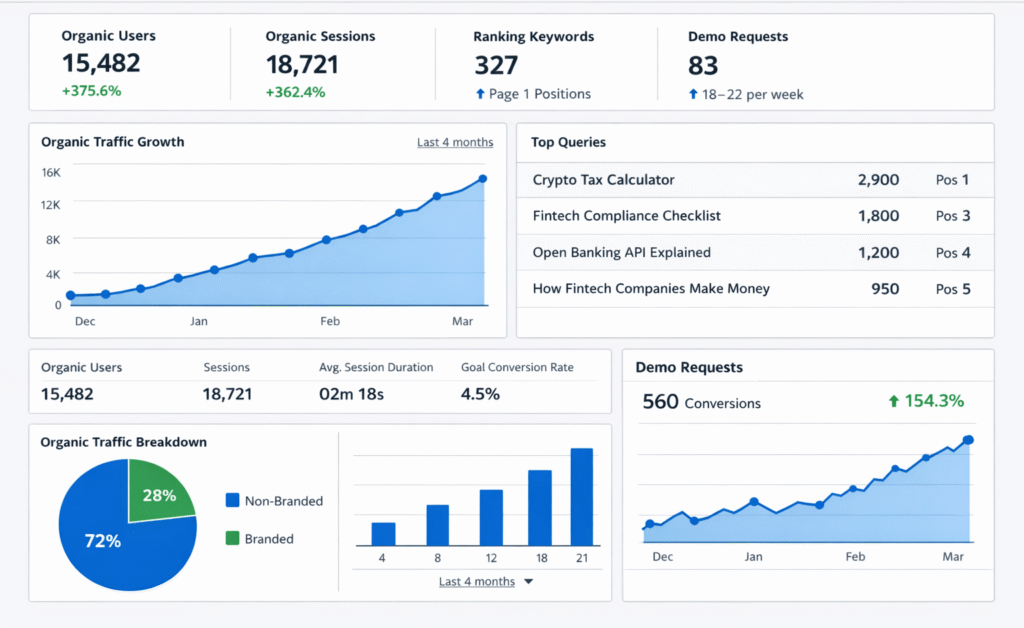
Within four months, the website reached 15,482 monthly organic visits and ranked for 327 keywords. Multiple fintech compliance topics secured page-one positions, with 72% of traffic coming from non-branded queries.
Weekly demo requests increased from approximately three per week to between eighteen and twenty-two. Traffic growth was not purely informational. A measurable portion of visitors progressed to demo requests and sign-ups, validating strong alignment between content strategy and product positioning.
What This Demonstrates
This project highlights how structured content SEO, when combined with technical readiness, can generate meaningful traction even in competitive, trust-heavy industries.
It demonstrates conversion-focused SaaS content planning, content-led SEO strategy development, advanced search intent analysis, disciplined keyword prioritization, topical authority architecture, and strong technical SEO fundamentals for new domains.
Next Growth Opportunities (Strategic Outlook)
With foundational traction established, the next phase would focus on accelerating authority and expanding acquisition channels.
High-authority backlinks to pillar content would amplify ranking stability and competitive positioning. Expanding into comparison and alternative-intent keywords would capture late-stage commercial demand. Introducing programmatic SEO assets such as templates and calculators would increase scalable search coverage. Strengthening brand mentions across fintech publications would reinforce credibility and trust signals.
These initiatives would compound organic acquisition and solidify long-term authority.
Need Similar Results?
If you’re launching or scaling a SaaS or fintech platform and want to build a sustainable organic acquisition channel, we can help design and execute a content-driven SEO strategy tailored to your growth stage.