How We Boosted a SaaS Invoice Generator’s Organic Traffic by 130% in 6 Months – and Turned SEO Into a Predictable Acquisition Channel
When a SaaS startup offering an invoice generator for solopreneurs approached us, they weren’t just looking for “more traffic.”
They were spending consistently on paid acquisition, but CAC was rising and organic sign-ups were inconsistent. They needed a scalable acquisition channel that would reduce dependency on paid ads and compound over time.
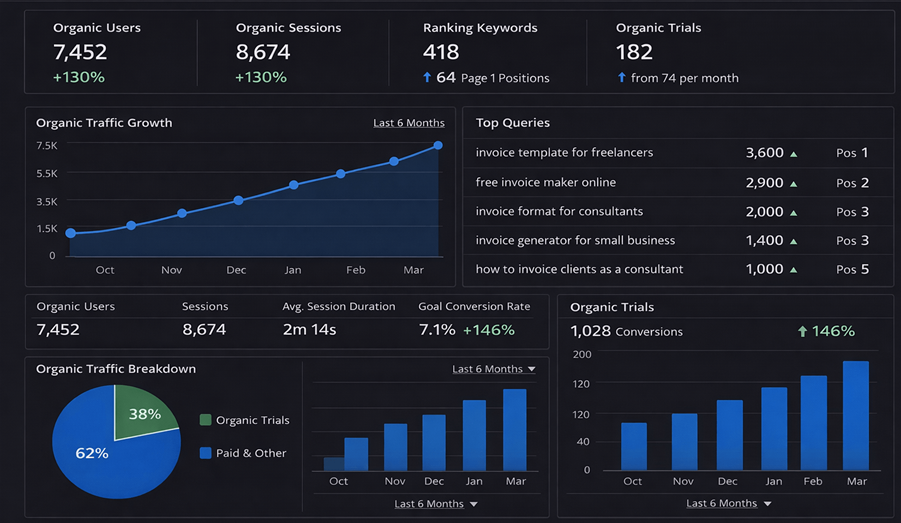
At the time of engagement, the website was generating 3,240 monthly organic sessions and 74 trial sign-ups per month from search. Six months later, organic traffic reached 7,452 monthly sessions; a 130% increase and organic-driven trials grew to 182 per month.
More importantly, organic became 38% of total new user acquisition, lowering blended CAC and stabilizing growth.
This is how we built that system.
The Starting Point
The product was strong. The positioning was clear. But organic visibility was weak.
The domain authority was 14. Only 18 pages were indexed. The website ranked for just 86 organic keywords, with only 7 on page one. High-intent keywords such as “free invoice generator” were dominated by established competitors with years of authority and backlinks.
Organic traffic averaged 3,240 sessions per month. Bounce rate was 68%. Average session duration was 57 seconds. The funnel leak was clear: low visibility, weak engagement, limited structured content.
From a founder’s perspective, this meant one thing which is over-reliance on paid channels.
The objective was not just traffic growth. It was acquisition diversification.
Strategic Objective
The goal was to increase organic traffic by at least 130% within six months while improving trial conversions from search.
But the deeper objective was to build organic as a predictable, scalable growth channel that could:
Reduce paid acquisition pressure
Capture high-intent users
Strengthen long-term brand equity
This required infrastructure, not just blog posts.
Phase 1: Technical SEO & Growth Infrastructure (Month 1)
Before scaling content, we fixed the foundation.
Critical pages were buried in poor navigation paths. Internal linking lacked structure. Metadata was duplicated across key landing pages. Mobile load time averaged 3.9 seconds – well above competitive benchmarks.
In Month 1, we restructured navigation around high-intent use cases. We implemented structured internal linking to strengthen topical relationships. Metadata was rewritten across 32 pages with clear keyword mapping and improved CTR positioning.
Page load speed was reduced from 3.9 seconds to 2.1 seconds on mobile. Crawl errors dropped to near zero. Indexed pages increased from 18 to 34.
Founders often overlook this stage – but without technical clarity, scaling content wastes runway.
Phase 2: Keyword & Market Intent Mapping (Months 1–2)
Rather than chasing only high-volume keywords, we mapped search intent to real user behavior.
We identified 210 commercially relevant keywords across three clusters:
Invoice Creation
Freelancer Finance Management
Client Payment Processes
Sixty-five of these were prioritized for immediate execution based on ranking feasibility and product alignment.
Instead of competing directly for only “free invoice generator,” we built supporting layers such as “invoice template for freelancers,” “how to invoice clients as a consultant,” and “invoice format for designers.”
This allowed us to capture users earlier in the journey – and move them toward the tool.
Phase 3: Content Production & Product Alignment (Months 2–5)
Over four months, we published 28 long-form educational articles and launched 12 optimized landing pages targeting template-based and workflow-based search intent.
Every article was structured to:
Answer a specific problem
Integrate the product naturally
Link strategically to related content
Guide users toward a frictionless trial
We implemented FAQ schema and how-to structured data, increasing visibility in rich results.
By Month 4, keyword rankings increased from 86 to 243. Page-one rankings grew from 7 to 28. Organic sessions crossed 5,900 per month.
More importantly, trial sign-ups from organic traffic began rising consistently – not in spikes, but in steady weekly growth.
Phase 4: Authority Building & Controlled Link Growth (Months 3–6)
To stabilize rankings, we executed a measured authority campaign.
We secured 19 guest contributions on freelancing and entrepreneurship platforms with domain ratings between 30 and 65. These links pointed primarily to pillar content, not just the homepage.
Referring domains increased from 62 to 118. Domain authority grew from 14 to 24.
No aggressive link spikes. No unnatural velocity. Just consistent credibility building.
This reduced volatility and strengthened competitive positioning in SERPs.
Results After 6 Months
Organic traffic increased from 3,240 to 7,452 monthly sessions – a 130% growth.
Ranking keywords expanded from 86 to 418. Page-one keywords grew to 64, including top-five positions for multiple invoice template variations.
Bounce rate improved from 68% to 51%. Average session duration increased from 57 seconds to 2 minutes and 14 seconds. Pages per session doubled from 1.3 to 2.6.
Trial sign-ups from organic search grew from 74 to 182 per month – a 146% increase.
Organic search now contributed 38% of total new sign-ups.
For the founders, this meant lower acquisition pressure and a more balanced growth model.
Why This Matters for SaaS Founders
SEO is often treated as a traffic channel. But for SaaS, it should be treated as an asset.
Paid acquisition stops when budget stops. Organic acquisition compounds.
Within six months, organic evolved from a weak supporting channel into a reliable contributor to new user growth. It did not replace paid – it reduced its risk.
That shift changes growth conversations inside a SaaS company.
Key Takeaways
Technical clarity enables scalable growth. Without it, content velocity wastes resources.
Topical authority beats isolated keyword targeting. Depth creates defensibility.
Conversion alignment is critical. Traffic without product integration does not move MRR.
Authority compounds gradually but strengthens competitive resilience.
SEO, when executed as a system, becomes a long-term acquisition engine – not a side project.
If you’re a SaaS founder looking to reduce CAC pressure and build a predictable organic acquisition channel, this is the framework we use to turn SEO into a growth asset rather than a content experiment.