How We Doubled Conversion Rates for an HR Software Company
A small-business-focused HR software startup approached us. They were facing a challenge that is common among early-stage SaaS companies. They had built a product that solved a real operational problem for small teams and solopreneurs, but their website was not attracting enough qualified organic traffic, and the traffic they did receive rarely converted into product signups.
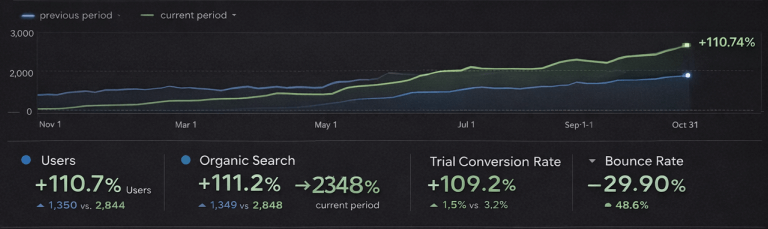
At the start of the project, the site generated around 1,350 monthly organic visitors, with most of that traffic coming from branded searches or a handful of blog articles targeting very broad HR topics. Despite this traffic, the website converted only 1.5% of visitors into free trial users, and the company relied heavily on outbound sales and referrals for growth.
The objective of the project was straightforward: build an SEO-driven growth engine that could both increase organic traffic and convert search visitors into product users.
Over a six-month period, a combination of technical SEO improvements, search-intent-driven content, and conversion-focused copywriting helped the company double organic traffic and significantly increase trial signups.
Initial SEO and Content Audit
The first phase focused on understanding why the website struggled to attract qualified search traffic.
Using Google Search Console, Ahrefs, and Screaming Frog, our SEO team analyzed the site’s technical structure, keyword rankings, and content performance.
The audit revealed several structural issues limiting the site’s organic growth.
First, the site ranked for only 72 keywords, and very few of them were commercially relevant. Most were informational queries such as “HR responsibilities” or “what HR does,” which brought in students or job seekers rather than business owners looking for HR software.
Second, the website had weak topical authority in HR software categories, meaning Google did not consider it a strong resource for high-intent searches like:
- HR software for small business
- HR management tools for startups
- simple HR system for teams
Third, the website’s technical structure created indexing inefficiencies. Several blog pages were not properly linked internally, and the site had multiple duplicate metadata issues that diluted keyword relevance.
From a conversion perspective, the messaging also created friction. Product pages focused on feature descriptions rather than explaining how the tool helped small business owners save time or reduce HR complexity.
These combined issues meant the website struggled both to rank for the right keywords and convert visitors once they arrived.
SEO Methodology and Strategy
Our strategy focused on three parallel initiatives: technical SEO improvements, building topical authority through content, and improving conversion-focused messaging across key landing pages.
The goal was to ensure that the website could first earn more visibility in search, then attract higher-intent visitors, and finally convert them into product users.
Our project roadmap included:
- resolving technical SEO issues that limited crawling and indexing
- developing a keyword strategy focused on commercial search intent
- building topic clusters around HR software searches
- improving internal linking and page hierarchy
- rewriting high-traffic pages using conversion-focused SEO copywriting
Technical SEO Improvements
Before scaling content production, our team focused on addressing the site’s technical limitations.
A full crawl using Screaming Frog identified over 140 technical SEO issues, including duplicate metadata, thin pages, and poorly structured internal links.
Over the next two months, our SEO specialists and content team implemented several improvements.
Page metadata was rewritten across 52 key pages to improve keyword relevance and click-through rates in search results. Duplicate title tags were eliminated, and meta descriptions were optimized to better reflect user search intent.
Internal linking was also redesigned. Many blog posts existed as isolated pieces of content with no clear relationship to the product pages. By creating contextual internal links between educational articles and the main product landing pages, our team strengthened topical relevance and guided readers toward conversion paths.
Page speed improvements were also implemented. Image compression and script optimization reduced average page load time from 3.9 seconds to 2.1 seconds, improving both user experience and Core Web Vitals performance.
Additionally, structured data was added to key pages, including software application schema and FAQ schema for high-intent landing pages. This helped improve search visibility and increased click-through rates for several important queries.
After these improvements were implemented, Google Search Console data showed a noticeable increase in crawl activity and indexed pages, allowing the new content strategy to gain traction more quickly.
Content Strategy and Production
Once the technical foundation was stabilized, our team shifted focus toward building topical authority around HR software.
Keyword research identified several clusters of commercial-intent keywords with moderate competition but meaningful search demand in the US market.
The primary keyword cluster centered on “HR software for small business,” which had approximately 3,600 monthly searches, along with related long-tail queries such as:
- best HR software for startups
- simple HR software for teams
- affordable HR tools for small companies
Instead of targeting these keywords with isolated articles, our strategy focused on building topic clusters.
A cornerstone landing page targeting “HR software for small businesses” served as the central authority page, supported by multiple related content pieces.
Over a four-month period, our team produced:
- 14 SEO blog articles
- 6 product feature pages
- 3 comparison pages
- 2 high-intent landing pages
In total, approximately 38,000 words of optimized content were published on the website.
Each piece of content was designed to match search intent, ensuring that informational articles addressed real HR challenges faced by small business owners while naturally introducing the software as a solution.
The internal linking strategy connected blog posts to relevant product pages, helping guide readers further down the conversion funnel.
Conversion-Focused SEO Copywriting
Alongside content expansion, our team rewrote several high-traffic pages to improve their conversion performance.
The homepage messaging was simplified to clearly communicate the product’s core value: helping small business owners manage HR tasks without needing a dedicated HR department.
Product pages were restructured to focus on outcomes rather than technical features. Instead of listing functionality, each section explained how the tool solved common operational challenges such as employee onboarding, payroll documentation management, and HR compliance tracking.
Additional trust elements were introduced, including early user testimonials and real-world use cases from small businesses. A clearer free-trial call-to-action was also integrated throughout the page structure to encourage visitors to test the software once they understood its value.
Results
Within six months of implementing the SEO strategy, the website experienced substantial growth in both search visibility and user acquisition.
Organic traffic increased from 1,350 monthly visitors to just over 2,850, representing a 111% increase in organic traffic.
The number of ranking keywords grew from 72 to 238, with several high-intent queries reaching the first page of Google search results.
The main landing page targeting “HR software for small business” improved from position 38 to position 9, becoming one of the website’s largest traffic drivers.
Engagement metrics also improved significantly. Average session duration increased from 1 minute 18 seconds to 2 minutes 5 seconds, while bounce rates decreased by nearly 20% on product-related pages.
Most importantly, the improved traffic quality translated into stronger conversions.
The free trial signup conversion rate increased from 1.5% to 3.2%, more than doubling the number of new product users generated through organic search.
As a result, organic search evolved from a minor traffic source into one of the company’s primary acquisition channels for new users.
Tools Used
Throughout the project, our team relied on several SEO and analytics tools to guide strategy and measure performance.
Keyword research and competitive analysis were conducted using Ahrefs, while Google Search Console provided insights into search queries, indexing improvements, and click-through rates.
Technical audits and site crawls were performed using Screaming Frog, and user behavior analysis relied on Google Analytics along with heatmap tools to better understand how visitors interacted with key landing pages.
These insights helped guide ongoing optimization and ensured that decisions were based on real user data.
Key Takeaway
This project demonstrated how combining technical SEO, search-intent-driven content, and conversion-focused messaging can transform organic search into a reliable growth channel for SaaS companies.
Rather than focusing solely on increasing traffic, aligning content with commercial search intent allowed the website to attract the right audience and guide them toward product adoption.
Within six months, the site achieved more than double its organic traffic and trial signups, proving that a well-structured SEO strategy can deliver measurable growth even for early-stage startups operating with limited marketing resources.