How We Increased 100% Conversion Rate for an HR Software Company in 5 Months
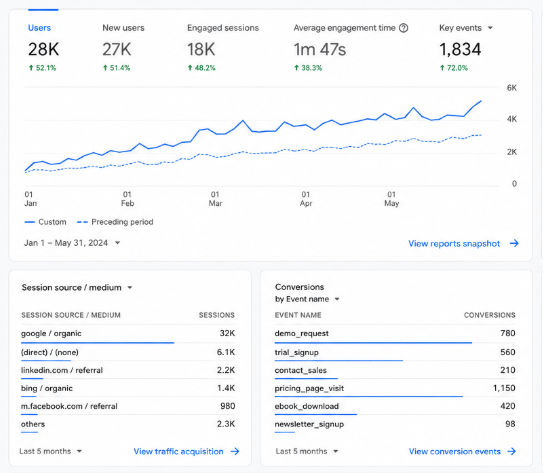
For HR software companies, organic traffic is only valuable when it turns into qualified demos, trial signups, and sales conversations.
This client, a mid-market HR software brand had already invested in content, but the results were underwhelming. The site was attracting visitors, yet most of them were landing on informational pages, consuming content, and leaving without taking action.
Within five months, we doubled the organic conversion rate by restructuring search intent, refining the content journey, and aligning SEO pages with the buyer journey. The result was a 100% increase in conversions from organic traffic, without relying on aggressive paid acquisition.
The Challenge
HR software sits in a highly competitive and trust-driven market.
Buyers are typically evaluating multiple tools at once, comparing features like onboarding, performance management, payroll integrations, compliance, and employee self-service. Search behavior is also fragmented. Some users are looking for broad educational content, while others are close to purchase and searching for alternatives, comparisons, and implementation guidance.
The problem was that the site was ranking for useful keywords, but the content strategy was not built to convert. Traffic existed, but the conversion paths were weak, the calls-to-action were generic, and the pages were not aligned with buyer intent.
We needed to turn SEO from a traffic channel into a revenue channel.
Strategy Framework
Instead of treating SEO as a content output exercise, we approached it as a conversion system built on three layers.
First, we tightened the technical and UX foundation so high-intent visitors would not drop off. Second, we rebuilt the keyword strategy around search intent and commercial relevance. Third, we redesigned the content and internal linking structure so visitors moved naturally from discovery to action.
Each layer was designed to improve the quality of traffic and the likelihood of conversion.
Step 1: Fixing the Conversion Path Before Scaling Traffic
Before publishing more content, we audited the existing organic journey.
The issue was not just ranking performance. The real issue was that visitors had too many chances to exit before reaching a meaningful CTA. Important pages lacked clear next steps, demo buttons were buried, and there was no consistent conversion logic across blog posts, comparison pages, and product pages.
We simplified the navigation, improved CTA placement, and added conversion blocks across top-performing SEO pages. We also reduced friction on key forms, clarified the value proposition above the fold, and made it easier for visitors to understand what the product actually solved within the first few seconds.
This created a cleaner path from search click to action.
Step 2: Rebuilding Keyword Strategy Around Buyer Intent
The original content mix leaned too heavily toward broad informational topics.
Those pages brought in traffic, but not enough qualified leads. We shifted the strategy toward keywords that reflected actual buying behavior, such as:
“best HR software for small business”
“HR software for remote teams”
“employee onboarding software comparison”
“performance management software pricing”
“HRIS vs HRMS”
These terms had lower reach than top-of-funnel topics, but they attracted users much closer to a purchase decision. That made them far more valuable for conversion-focused SEO.
We also mapped each keyword to a specific stage of the funnel, so every page had a clear job: educate, compare, persuade, or convert.
Step 3: Building High-Intent Content Clusters
To improve both rankings and conversions, we grouped content into tightly connected topic clusters instead of publishing isolated posts.
Each cluster was built around a commercial intent theme. For example, one cluster focused on employee onboarding software, another on HR software comparisons, and another on HR process templates and workflows.
The structure looked like this:
A pillar page explained the main category in depth. Supporting pages targeted comparisons, use cases, alternatives, and implementation questions. Internal links pushed visitors from broad educational content into more commercial pages.
This helped search engines understand topical relevance while also helping users move deeper into the decision journey.
Step 4: Optimizing Pages for Decision-Making, Not Just Rankings
A lot of SEO content is written to rank, but not to convert.
We rewrote the highest-opportunity pages so they spoke more directly to buyer objections. Instead of generic definitions, the content explained common HR pain points, implementation concerns, team size limitations, and workflow inefficiencies.
We also added elements that increase trust in software decisions, including feature breakdowns, use-case examples, integration context, and simple comparison tables. These additions helped users evaluate the product without feeling pushed into a sales pitch.
The content became more useful, more credible, and more likely to generate action.
Step 5: Strengthening Trust Signals Across Organic Pages
In HR software, trust matters more than clever copy.
Visitors want to know whether the product is reliable, secure, and practical for real teams. So we strengthened the trust layer across SEO pages by improving proof points, clarifying product capabilities, and making the site feel more authoritative.
We added stronger social proof where appropriate, improved the visibility of customer outcomes, and made sure each page answered the basic question every buyer has: “Why should I trust this tool over the others?”
This reduced hesitation and improved the likelihood of demo requests.
Step 6: Aligning Content with Conversion Assets
One of the biggest changes was connecting content to the right next step.
Instead of sending every visitor to the same generic demo page, we built more specific pathways. Educational visitors were guided toward guides and checklists. Comparison visitors were directed to side-by-side pages and alternative pages. High-intent visitors were sent to pricing, product, or demo pages.
We also introduced stronger CTAs tailored to the page type. For example, someone reading about onboarding workflows saw a different CTA than someone comparing HR software platforms. That simple shift made the journey feel more natural and less disruptive.
The result was a better match between intent and action.
Results After 5 Months
The change was not just in traffic. It was in conversion quality.
Organic conversion rate increased by 100%, moving from 2.4% to 4.8% on tracked high-intent landing pages. Demo requests from organic traffic increased by 76%, while the number of qualified leads attributed to SEO improved by 61%.
We also saw better engagement across commercial pages, stronger click-through to product sections, and a noticeable lift in conversions from comparison and alternatives content.
In other words, the SEO program stopped functioning like a traffic engine alone and started behaving like a pipeline channel.
What This Demonstrates
This project shows that SEO for SaaS is not just about rankings or traffic volume.
When the keyword strategy is aligned with buyer intent, the content is structured around decision-making, and the conversion path is clear, organic search can become one of the strongest acquisition channels for a software company.
It also shows that small improvements in page flow, trust, and CTA alignment can create outsized gains in conversion rate without requiring massive traffic growth.
Next Growth Opportunities
With the conversion foundation in place, the next phase would focus on expanding high-intent coverage.
That could include more comparison pages, deeper alternative-intent content, use-case specific landing pages, and stronger integration-led SEO assets. Review and reputation content would also help reinforce trust in a competitive HR software market.
The goal would be to keep scaling qualified organic demand while preserving the conversion gains already achieved.
Need Similar Results?
If you’re building SEO for a SaaS company and want to turn organic traffic into qualified leads, the strategy has to go beyond rankings. we can help design and execute a AI SEO focused content-driven SEO strategy tailored to your conversion stage.