
Digital PR and SEO: How to Build Authority, Earn Links, and Win AI Search Visibility
Most SaaS brands are publishing content at full throttle. And they are going nowhere fast.
Three blog posts a week. Keyword clusters. Topic pillars.
And yet.
Flat organic traffic, stagnant pipeline, and a domain authority that has been hovering in the same range for 18 months.
Here is the uncomfortable truth.
Your content investment may be subsidizing your competitors’ rankings. While you are focused on production volume, they are building the one thing Google and AI systems actually reward- Earned authority.
That is what digital PR and SEO integration delivers.
Not just links. Not just press.
A compounding system that feeds search engines, LLMs, and human buyers the third-party trust signals they need before they ever consider clicking “Start Free Trial.”
This guide breaks down exactly how it works.
You will learn what digital PR for SEO actually is, why it has become the most critical lever in modern search visibility, and how to execute it step by step.
What Digital PR for SEO Actually Means
Digital PR gets used to describe everything from a press release distribution service to a full-stack content-and-media strategy.
That ambiguity is costing marketers real money.
Digital PR vs. Traditional PR vs. Link Building
Digital PR is a reputation-first strategy. Links are proof that it worked, not the reason you are doing it.
Here is the distinction most content skips entirely.
Traditional PR is reputation management. It is brand narrative, crisis response, and media relationships, primarily offline or broadcast-oriented. Success is measured in share of voice and sentiment.
Link building is a technical SEO tactic. It is about acquiring hyperlinks to improve domain authority and pass PageRank signal. At its worst, it is transactional and purely mechanical.

Digital PR for SEO is the strategic intersection of both. It produces something neither discipline achieves alone: editorial-quality backlinks from authoritative publications, earned through genuinely newsworthy content, that simultaneously build brand credibility and send authority signals to search engines.
The confusion around “digital PR links” and “digital PR link building” reflects a real conceptual gap. Most practitioners treat links as the goal. They are not. They are the byproduct.
The 7 Types of PR and Where Digital PR Fits
Digital PR is not media relations with a press release attached. It is a modern discipline built around measurable authority outcomes.
Most guides treat PR as a monolith.
However, it is not.
The field has seven distinct disciplines:
- Media relations: Proactive journalist and publication outreach
- Community relations: Brand presence and trust within local or industry communities
- Crisis PR: Reputation protection and damage control
- Internal communications: Employee-facing messaging and culture
- Public affairs: Government, regulatory, and policy engagement
- Investor relations: Capital market communications
- Social media PR: Platform-native reputation and community management
Digital PR for SEO operates primarily within media relations.
But it borrows from community and social media PR to amplify reach. The key differentiator is intent.
Every digital PR campaign should be engineered to generate measurable search and AI visibility outcomes, not just coverage.
Core Goal: Reputation and Authority, Not Just Backlinks
Links are a signal of authority. The actual deliverables are reputation, topical trust, and brand entity recognition.
Here is the metric most digital PR campaigns optimize for incorrectly: raw link count.
Volume is not the signal. Authority, trust, and topical relevance are the signals. A single link from a credible editorial source in your niche outperforms dozens of directory placements or generic guest posts.
Mass-produced guest post links or low-relevance directory citations often provide little to no measurable ranking benefit.
A placement in TechCrunch, VentureBeat, or a respected trade publication can shift domain trust in ways that compound over months.
More importantly, Google’s systems and AI answer engines now treat brand entity recognition as a core ranking and citation input.
This means who you are, what you are known for, and which authoritative sources reference you all factor in. That is not built through link acquisition.
It is built through sustained, high-quality earned media.
Why Digital PR Matters for Modern SEO and AI Search
The SaaS market recorded roughly $250 billion in revenue in 2024, approximately two-thirds of total public cloud services revenue.
By 2026, projections put that figure north of $512 billion. At that scale, feature differentiation collapses. Buyers default to trusted brands. And trust, at scale, is built through earned media.
Meanwhile, earned-media and PR-related budgets among high-growth SaaS vendors are projected to double by 2026 versus 2022 levels. These are driven directly by the rise of generative AI search and Generative Engine Optimization (GEO) demand.
The brands figuring this out now are buying five-year category dominance. The brands still running pure content-volume strategies are feeding a machine that is losing relevance.
Google’s E-E-A-T and How Digital PR Builds Each Signal
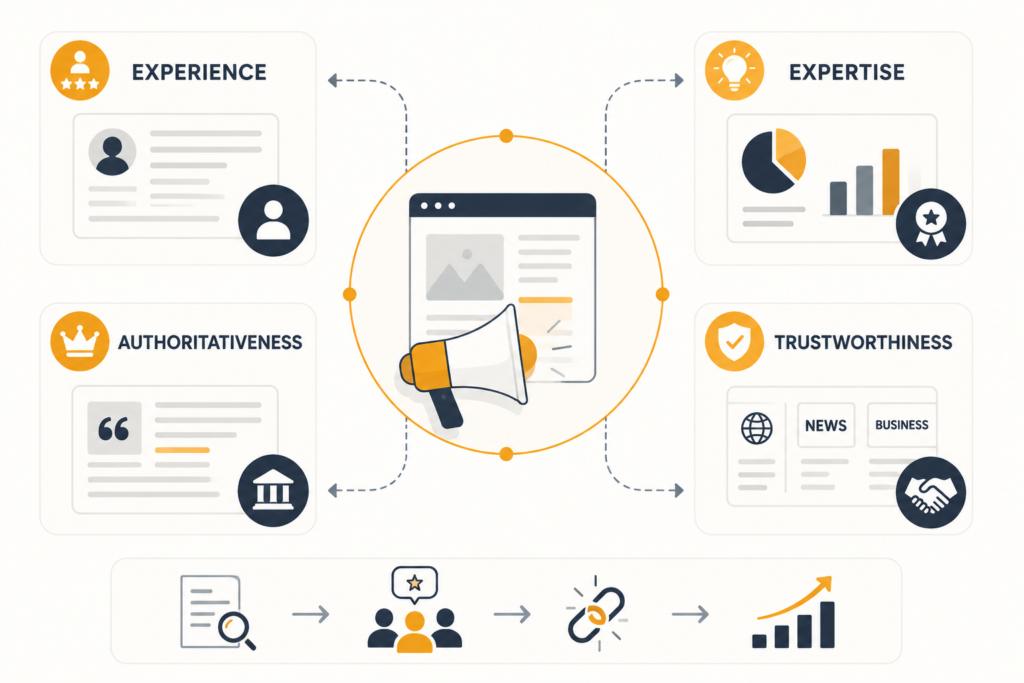
Digital PR is the most scalable mechanism for building all four E-E-A-T signals simultaneously. It is the only approach that relies on third-party validation rather than self-assertion.
Google’s quality framework covers Experience, Expertise, Authoritativeness, and Trustworthiness. It sounds abstract until you map it to specific digital PR outputs.
- Experience: Author bylines in respected publications signal real-world practitioner experience. A journalist quoting your CEO on industry trends demonstrates that someone with direct experience is behind the brand.
- Expertise: Proprietary research, original data studies, and industry reports published on high-authority domains establish topical depth that content-only strategies cannot fake.
- Authoritativeness: Third-party editorial citations are the clearest authority signal in Google’s evaluation model. These are not links you earned through outreach tools. These are links a journalist chose to include because your content was genuinely useful.
- Trustworthiness: Consistent brand mentions across publications your target audience already reads builds the kind of implicit endorsement that no owned-content strategy can replicate.
Most competitor articles mention E-E-A-T in a paragraph and move on. This is the actual playbook.
How AI Systems Use Earned-Media Data: Mentions, Backlinks, and Citations
This is the part almost no one explains clearly. How does digital PR actually influence what ChatGPT, Gemini, Perplexity, and Claude say about your brand?
Large language models are trained on web-crawled data from authoritative sources.
When search engines repeatedly see your brand in trusted sources, they start connecting your name with authority and relevance in your industry.
This happens when your brand is:
- Mentioned in credible editorial content
- Cited in industry studies and research
- Quoted in trade publications
- Linked from high-authority (high-DA) websites
Over time, these signals help search engines build an associative model of your brand.
Beyond training, AI retrieval systems actively crawl and reference current web content when generating answers.
If your original research has been picked up by authoritative publications, it becomes part of the retrieval corpus those systems pull from.
The practical implication is this.
AI visibility is the new page one. A brand that does not appear in AI-generated answers to buyer questions in its category is effectively invisible to a growing segment of high-intent searchers.
AI answer engines do not cite brands arbitrarily. They cite entities with consistent, authoritative, cross-platform editorial presence. Digital PR builds that presence systematically.
How Digital PR and SEO Drive Rankings and Visibility
Let us get specific about the mechanism. How does digital PR and SEO integration actually move rankings?
Direct SEO Impact: Backlinks, Domain Authority, and Internal Link Opportunities
One authoritative editorial link is worth more to your domain trust than a dozen links from generic outreach.
Every editorial placement earns you at least one backlink. But not all backlinks are equal. The type digital PR earns is categorically different from what traditional link building produces.
Editorial links from press coverage carry several properties that mass outreach links do not.
- Higher topical authority transfer: A link from a publication that covers your exact niche passes more relevant authority than a link from a generic DA-80 site.
- Natural anchor text diversity: Journalists choose their own anchor text, creating a diverse, organic-looking profile that contrasts with outreach-driven link campaigns where anchor distribution is deliberately controlled.
- Followed links are the goal, but mentions still count: Most press placements include followed links. Where they do not, the unlinked brand mention still contributes to entity recognition, a signal Google’s systems increasingly use.
The data backs this up. Top-ranking pages hold 3.8 times more backlinks than pages ranking in positions 2 through 10. That gap is not closed by producing more content. It is closed by earning more editorial coverage.
Indirect SEO Impact: Branded Search, Traffic Spikes, and SERP Real Estate
Here is the metric most digital PR reporting ignores!
branded search volume lift.
When a major publication covers your brand, a predictable cascade follows:
- Direct referral traffic hits your site, measurable in GA4
- Readers who do not click immediately search your brand name later
- Branded search volume increases and becomes visible in Google Search Console
- Google interprets that branded demand signal as a trust indicator
- Your domain earns incremental SERP visibility over the weeks following coverage
Among high-growth SaaS vendors, earned digital PR and influencer-driven content now account for roughly 40% of measurable top-of-funnel brand awareness, up from approximately 20% in 2020.
That is a near-doubling of earned media’s share of awareness generation in four years.
The underlying cause is B2B buyers increasingly rely on third-party validation before they engage with vendor-owned content.
Framework for estimating indirect impact
One of the most practical ways to measure the indirect SEO value of a digital PR campaign is to track changes in branded search demand.
When your company is featured in respected publications, industry reports, podcasts, or expert roundups, more people become aware of your brand. Some of those readers won’t click your link immediately. Instead, they will search for your company name later on Google.
This increase in branded searches is a strong signal that your digital PR efforts are expanding brand recognition and generating demand beyond direct referral traffic.
Step 1: Establish a Baseline
In Google Search Console, record branded keyword impressions, clicks, and click-through rates for the 30 days before a major media placement.
Track queries that include:
- Your company name
- Product name
- Founder name
- Common brand-related modifiers (for example, “[Brand] pricing,” “[Brand] reviews,” or “[Brand] alternatives”)
Step 2: Monitor the 30 Days After Coverage
After the article, interview, or research mention goes live, compare the next 30 days of branded search performance against your baseline.
Look for changes in:
- Total branded clicks
- Branded impressions
- Number of unique branded queries
- Average ranking position for branded terms
For mid-market SaaS companies, a significant feature in a well-known industry publication often leads to a 15% to 30% increase in branded search clicks. The exact lift depends on the authority of the publication, audience relevance, and how prominently your brand is mentioned.
Step 3: Control for Other Variables
To isolate the impact of digital PR, note any other campaigns running during the same period, such as:
- Paid advertising
- Product launches
- Webinars
- Conference sponsorships
- Email campaigns
If no major marketing activities overlap, the increase in branded search demand can be attributed more confidently to your PR coverage.
Step 4: Connect Brand Demand to SEO Performance
Higher branded search volume creates secondary SEO benefits.
As more users search for your company and engage with your site, search engines gather stronger signals about your brand’s relevance and popularity. Over time, this can contribute to:
- Improved rankings for non-branded keywords
- Higher click-through rates in search results
- Faster indexing and crawling
- Stronger topical authority
- Better conversion rates from organic traffic
Example
Suppose your SaaS brand averages 2,000 branded clicks per month. After being featured in a respected publication such as TechCrunch or G2, branded clicks increase to 2,500 over the following 30 days.
That 25% lift indicates that the coverage generated meaningful awareness, even if referral traffic from the article itself was modest.
AI Search Visibility: How AI Systems Cite Data-Driven PR Content
There is a specific feedback loop that the most sophisticated digital PR practitioners are engineering deliberately. Call it the citation flywheel.
- You publish original research or a proprietary data study
- A journalist at an authoritative publication cites it in a story
- That story earns a backlink to your campaign landing page
- AI crawlers index both the publication’s story and your original research
- When AI systems answer queries related to your topic, they pull from those authoritative sources
- Your data is cited in AI answers, driving discovery from a new audience
- That discovery drives more press interest and the cycle compounds
The content formats AI systems favor for citation are specific. They want structured data, original statistics with clear methodology, expert quotes with named attribution, and definitional content with unambiguous answers.
Vague thought leadership and derivative roundups do not generate AI citations. Original, verifiable, well-structured research does.
The Best Content Formats for Digital PR and SEO Campaigns
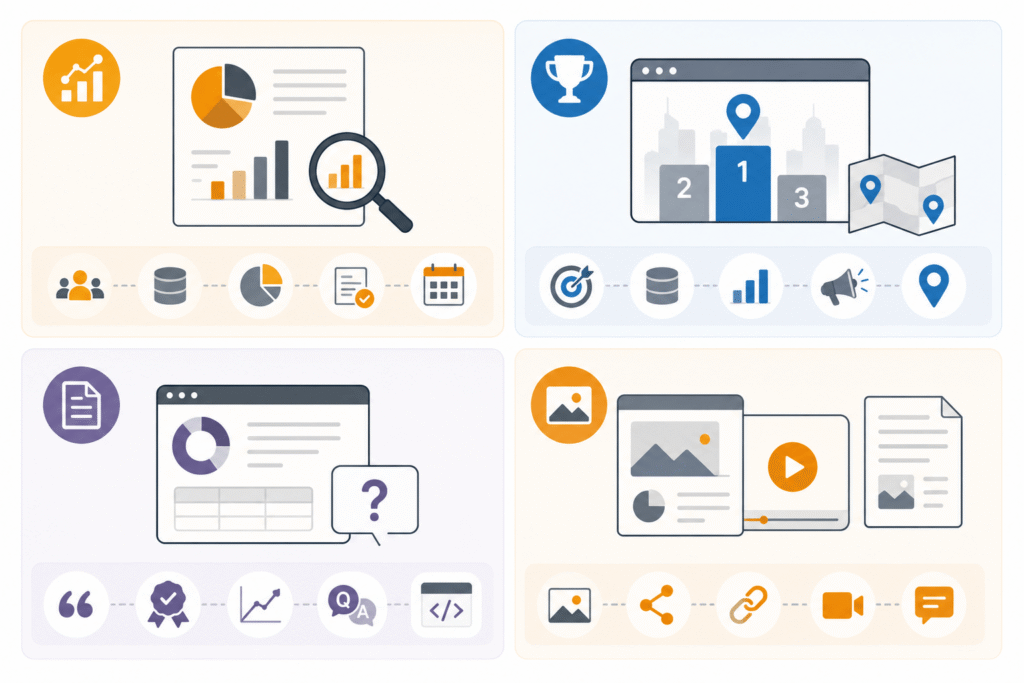
Not all content earns editorial links. These formats do.
Data-Driven Reports and Proprietary Research
Original data is the number-one most linkable asset in digital PR. Period.
When you publish findings that do not exist anywhere else,
you create something extremely valuable.
This includes:
- Survey results from your own customers
- Analysis of proprietary platform data
- Public datasets combined into a completely new perspective
As Stacy Walden of Siege Media has argued –
SaaS brands specifically should focus on turning customer data into industry-wide studies rather than generic content campaigns. This research-as-PR approach systematically attracts high-authority links and positions the brand as a market-insight leader, not just another vendor publishing opinion posts.
Practical basics to follow:
- Run surveys with at least 500 respondents for statistical credibility
- Frame findings around industry-level implications, not product benefits
- Publish methodology transparently because journalists and AI systems both prioritize credibility signals
- Time releases to news cycles or annual industry events
“Best Cities,” Industry Indexes, and Ranked Lists
Index-style content earns links from multiple outlet categories simultaneously.
Local media write about wherever their city ranked. Trade publications cover the methodology. Aggregators reference the findings for years afterward.
The repeatable formula looks like this:
- Select a metric with clear industry relevance
- Collect and clean data from public or proprietary sources
- Design visual assets that make ranking clear at a glance
- Write a press release angled toward the winners because they will amplify organically
- Pitch local angles to regional outlets alongside national trade pitches
The built-in amplification mechanic, where winners share their ranking, is what makes index content a link-earning machine rather than a one-time campaign.
Evergreen Statistics Pages and FAQ-Style Articles
Statistics pages are the passive income of digital PR. A well-structured “X statistics about Y” page earns citations from journalists, researchers, and AI systems for years after publication, often without any active outreach.
Why? Because journalists covering your topic need data points. If your page is the cleanest, most credible, most current source for statistics in your niche, it becomes their default citation target.
FAQ schema markup amplifies this further. AI systems are specifically engineered to surface content that directly answers discrete questions. A statistics page combined with FAQ schema creates dual coverage: traditional SERP position plus AI citation potential.
Visual Explainers, Infographics, and Video PR Hybrids
Visual assets are link multipliers. They lower the barrier to coverage by giving journalists something polished they can use immediately.
Visual assets extend the shelf life of every PR campaign. A well-designed infographic gives journalists a ready-made embed, reducing their production burden and dramatically increasing the likelihood of coverage. Each embed includes a backlink.
Beyond traditional press, visual assets earn links from resource pages and educational sites that need reference graphics, from social media posts that often link back to the source, and from industry newsletters that embed images with attribution.
Video transcripts and visual alt-text also contribute to AI-indexable content. That is another reason to treat multimedia as a first-class SEO asset, not an afterthought.
Step-by-Step Digital PR and SEO Workflow
Here is the full process. No hand-waving. No vague advice about “building relationships.”
Step 1: Align PR and SEO Goals Before You Start
The single most common reason digital PR campaigns fail to move SEO metrics is simple: the PR team and the SEO team are optimizing for different things.
Misaligned goals are the number-one campaign killer. Alignment is not a kickoff call. It is a living brief everyone uses weekly.
Before a single press release is drafted, you need to define the following:
- Target keywords the campaign should support, matched to SERP opportunity and not just brand narrative
- DA thresholds for target publications so you are not wasting pitching cycles on DA 20 sites when your gap sits at DA 60+
- AI visibility benchmarks, specifically which AI queries you want to appear in 90 days from now
- Internal KPIs with a clear owner for each metric and a clear reporting cadence
A shared campaign brief is the contract between PR and SEO. Without it, you are running two separate campaigns that happen to share a budget.
Step 2: Keyword and Topic Research with AI Assistance
Here is the sequencing most teams get backward. They pick a PR angle based on what is interesting, then check whether it has SEO value.
Invert it.
Start with keyword research. Identify queries with real search volume in your target segment. Pull People Also Ask data to map the questions your audience is actively asking.
Then use AI tools to identify which of those questions journalists are currently covering and which angles are underserved by existing content.
The PR campaign angle should emerge from that intersection: high search demand plus active journalist coverage plus content gap equals maximum campaign leverage.
Step 3: Develop Data-Driven PR Content
The strength of your data is the strength of your campaign. Credibility gaps get caught by journalists or, worse, by AI systems that deprioritize low-authority claims.
The content creation sequence works like this:
- Ideation: What original angle does your data make possible? Not what does your product team think is interesting.
- Data gathering: Survey your customer base, aggregate public datasets, or commission a panel study.
- Credibility validation: Before pitching anything, stress-test your methodology. One weak data point can disqualify an otherwise strong campaign.
- Narrative framing: What is the headline finding? Lead with the most surprising or counterintuitive data point.
- Asset production: Campaign landing page, press release, data visualization, and a pitch-ready summary document.
Quick validation checklist before pitching:
- Sample size is defensible (n greater than or equal to 500 for surveys)
- Methodology is transparent and reproducible
- Findings are genuinely new and not restating what already exists
- Data has been reviewed by a subject-matter expert
Step 4: Build a Targeted Media Outreach List
Spray-and-pray does not work. It never did.
A targeted list of 50 journalists who genuinely cover your beat outperforms a blasted list of 500 generic contacts every time.
Why?
Because relevance increases open rates, personalization increases response rates, and relationships increase repeat coverage.
Build your list by focusing on the following:
- Beat segmentation: Use Muck Rack or Cision to filter journalists by topic coverage and recent articles.
- DA prioritization: Target publications at the DA level that will actually move your domain metrics.
- Audience alignment: Choose publications your buyers actually read, not just high-DA outlets that happen to cover your industry tangentially.
- Tools: Muck Rack, Cision, HARO/Connectively for reactive opportunities, and SparkToro to find where your audience actually gets information.
Step 5: Craft AI-Friendly, Answer-Ready Campaign Landing Pages
Your campaign landing page is not a press release. It is a permanent SEO asset and it should be engineered to rank, earn links, and be cited by AI systems simultaneously.
Page structure that works:
- H1: Clear, keyword-informed title that states the core finding
- Summary block: 3 to 5 bullet points capturing the top findings because AI systems favor discrete, skimmable data
- Methodology section: Transparent and verifiable, which is required for AI citation credibility
- Full findings: Structured with H2 and H3 hierarchy and data visualizations
- Expert quotes: Named attribution increases journalist pickups and AI citation probability
- FAQ section with schema markup: Directly answers the questions your audience is searching
- Download CTA: Capture leads from the organic traffic the campaign earns
Add FAQ schema, How-To schema where relevant, and validate with Google’s Rich Results Test before launch.
Step 6: Track, Report, and Iterate on SEO and AI Visibility Signals
What gets measured gets improved. And what gets measured gets budget approved next quarter.
Full measurement stack:
- Backlinks earned: Volume, domain authority, and anchor text diversity tracked in Ahrefs or Semrush
- DA of placements: Are you hitting your DA thresholds and improving over time?
- Referral traffic: GA4 segmented by publication
- Branded search lift: Google Search Console, comparing 30 days before versus after major coverage events
- AI citation tracking: Manual spot-checks in ChatGPT, Perplexity, and Gemini for target queries, plus Perplexity Brand Monitoring for broader tracking
- Keyword ranking movement: Did the authority lift from coverage move target keyword positions?
- Pipeline contribution: As Neil Patel has consistently argued, digital PR must ultimately be measured through assisted conversions and pipeline contribution, not just domain authority or mention counts. Map coverage to branded search to trial starts or demo requests.
If your digital PR report ends at “links earned,” you are leaving the most important metric out. Connect every signal to pipeline.
Optimizing Digital PR Content for AI Search
This is the most underserved topic in the digital PR space. Most practitioners build for search engines. The fastest-growing visibility channel right now is AI answer engines and they have distinct requirements.
Structuring Content for AI Answers: Headers, FAQs, Schema, and Clear Definitions
AI systems are built to extract discrete, verifiable answers to specific questions. That shapes everything about how your content should be structured.
Practical requirements to implement:
- Unambiguous definitions: Every core term in your content should have a clear, one-sentence definition that an AI can quote directly. Do not assume the reader knows what “topical authority” means. Define it.
- FAQ schema: Implement structured FAQ markup on every campaign page. It is the single highest-leverage schema type for AI citation probability.
- HowTo schema: For process-oriented content, HowTo schema makes step sequences directly parseable by AI retrieval systems.
- Clear H1, H2, and H3 hierarchy: AI systems use heading structure to understand content organization. Each heading should be answerable as a standalone question.
- Speakable schema: For content that may surface in voice or audio AI interfaces, speakable markup helps AI systems identify citation-worthy passages.
Write for humans. Structure for machines. AI answers the questions your headers ask, so make every header a question worth answering.
Avoiding AI Traps: Over-Summarization, Low-Value Stats, and Misleading Claims
AI systems have become sophisticated evaluators of content credibility. Publishing vague, derivative, or methodologically weak statistics does not just fail to earn citations. It can actively signal low authority.
The specific traps to avoid:
- Derivative statistics: Restating stats from other sources without adding original analysis. AI systems cross-reference claims. If your “original” stat already exists verbatim elsewhere, you are not the authoritative source.
- Vague claims without methodology: Writing “Studies show that X…” without attribution, sample size, or source is the fastest path to AI deprioritization.
- Misleading framing: AI retrieval systems increasingly evaluate claim accuracy against consensus. A misleading headline that conflicts with the underlying data can disqualify an otherwise strong piece.
- Over-summarization: Content that compresses everything into bullet points without substantive explanation lacks the depth AI systems need to extract credible, citable answers.
Credibility is the entry fee to AI citation. One weak data point can invalidate an otherwise strong piece.
How to Make Your Content More Likely to Be Cited by AI Systems
Concrete checklist to work through before publishing:
- Original data: Published findings that do not exist anywhere else in this framing
- Clear attribution: Named author with verifiable credentials and a named data source with methodology
- Expertise signals: Author bio with relevant experience and organizational affiliation
- Published on authoritative domains: Campaign placement should be on a DA 60+ site when possible
- Consistent brand mentions: Your brand name appears consistently across the authoritative sources AI systems already trust
- Structured, discrete answers: Every claim is a standalone, verifiable unit and not embedded in a long discursive paragraph
- FAQ schema: Implemented and validated before launch
The citation flywheel works like this. One AI citation drives more press discovery. More press writes about you. More authoritative sites link to your research. AI systems encounter your brand in more credible contexts. On the next query, your content is cited again.
AI citation is a compounding asset. Build content designed to start the flywheel, not just spin it once.
Templates and Tools for Digital PR and SEO Campaigns
PR-SEO Campaign Brief Template
Use this before every campaign. Share it across PR, SEO, and content teams.
CAMPAIGN BRIEF

Campaign Name: ___________
Primary Target Keyword: ___________
Secondary/Related Keywords: ___________

Campaign Angle: ___________
Core Finding / Data Hook: ___________
Data Source: ___________
Methodology Summary: ___________

Target Publications:
  - Tier 1 (DA 70+): ___________
  - Tier 2 (DA 50-69): ___________
  - Trade/Niche (high relevance): ___________

DA Minimum for Link Credit: ___________
AI Visibility Target Queries: ___________

KPIs:
  - Links to earn: _____ at DA _____ minimum
  - Referral traffic target: _____/month
  - Branded search lift target: ____%
  - Pipeline attribution target: $_____ or ___ trial starts

Timeline:
  - Data collection complete: ___________
  - Landing page live: ___________
  - Outreach begins: ___________
  - Coverage reporting window: ___________

Responsible owners: SEO lead ___, PR lead ___, Content lead ___
A shared brief is the contract between PR and SEO. Without it, the teams optimize for different things and the campaign underperforms.
Journalist Pitch Email Template (with AI-Assisted Variant)
Standard pitch:
Subject line: [Data point] + [Surprising finding] for [relevant audience]

Hi [First name],

[One sentence proving you read their work, referencing a specific article and a specific insight.]

We just finished a study of [n = X audience type] on [topic]. The headline finding: [most counterintuitive or specific data point].

The full data is live at [campaign URL]. Happy to share the raw dataset and arrange a quote from [named expert].

Would this fit what you are working on?

[Your name]
[Organization]
[One-line proof of credibility]
AI-assisted personalization variant:
Prompt for any LLM: “Here are a journalist’s last five articles: [paste URLs or summaries]. Here is my campaign’s core data point: [insert]. Write three different pitch subject lines tailored to this journalist’s coverage style and a two-sentence hook that connects our data to their most recent story.”
Use AI for personalization at scale. Keep the data, the credibility signals, and the human judgment in your hands.
A pitch is a headline. If the first line does not earn the second, nothing else matters.
Recommended Tool Stack: PR, SEO, and AI Visibility
Outreach and media relations:
- Muck Rack: journalist search, beat monitoring, pitch tracking
- Cision: enterprise-grade media database and analytics
- Prowly: mid-market PR platform with strong pitch workflows
- HARO/Connectively: reactive PR opportunities from journalists seeking expert sources
SEO tracking and backlink analysis:
- Ahrefs: backlink analysis, domain authority tracking, keyword ranking
- Semrush: full-funnel SEO platform, authority scoring, competitor gap analysis
- Majestic: Trust Flow and Citation Flow metrics for link quality evaluation
AI visibility monitoring:
- Perplexity Brand Monitoring: tracks your brand citations in AI-generated answers
- Manual spot-checks in ChatGPT, Gemini, and Claude for target queries
- SearchGPT tracking tools (emerging, monitor for updates)
Content and campaign assets:
- Google Search Console: branded search volume tracking, free and essential
- GA4: referral traffic segmentation by publication
- Screaming Frog: technical SEO validation for campaign landing pages
The right tools reduce campaign time by 40 to 60%. But only if the strategy underneath them is sound first.
Campaign Landing Page Structure for Earned-Media Campaigns
[HERO SECTION]
H1: Keyword-informed title stating core finding
Subhead: One sentence expanding the finding with context
CTA: Download full report / Read methodology
Stats callout box: Top 3 findings in numbers

[KEY FINDINGS]
H2: What We Found
Skimmable numbered findings (3 to 7)
Each finding: stat + one-sentence implication

[METHODOLOGY]
H2: How We Collected the Data
Sample size, data sources, collection period, limitations
Required for AI citation credibility

[FULL DATA]
H2: The Full Breakdown
Charts, tables, and visual assets
Each visual: clearly labeled, with alt-text written for AI indexability

[EXPERT QUOTES]
H2: What the Experts Say
3 to 5 named expert quotes with credentials
Named attribution increases both journalist pickup and AI citation

[FAQ SECTION]
H2: Frequently Asked Questions
5 to 8 FAQ items with FAQ schema markup
Questions matched to target PAA queries

[CTA]
Download the full dataset / Book a strategy call / See how [Product] helps with [problem]
Digital PR and SEO for Different Audiences and Use Cases
Agencies vs. In-House SEO and PR Teams
The tactics are the same. The operational reality is entirely different.
Agencies need:
- Repeatable campaign templates that reduce setup time across clients
- Reporting frameworks that clearly attribute digital PR outcomes to SEO metrics for client retention
- Pitch volume management to run multiple campaigns simultaneously without quality collapse
- White-label tools and deliverables that position the agency as the authority, not the software
In-house teams need:
- Cross-functional alignment frameworks to bring SEO and PR under shared KPIs
- Budget justification models that connect digital PR spend to pipeline, which is essential for internal buy-in
- Long-term brand authority roadmaps that survive leadership changes and quarterly reforecasting
- A single campaign brief that every stakeholder including the CMO, content lead, and SEO director has signed off on
Same tactics. Entirely different org dynamics. Your workflow has to reflect which environment you are operating in.
SMEs and Bootstrapped Brands: Digital PR on a Budget
You do not need a $50,000 research budget to earn editorial links.
Low-cost data sourcing options that actually work:
- Freedom of Information Act requests: Public sector data that is freely available and underused by most marketers
- Government and academic datasets: Eurostat, the Office for National Statistics, Census Bureau data
- Reddit and social aggregation: Sentiment analysis across large communities creates legitimately unique data angles
- Your own CRM and product data: Aggregated and anonymized customer behavior data is an original asset you already own
Reactive PR, also known as newsjacking, is the zero-budget entry point. When a major news story breaks in your industry, you have a 48 to 72 hour window to position yourself as an expert source. Journalists writing breaking stories need quotes fast. A well-timed, credible expert comment via HARO/Connectively or a direct Twitter/X pitch can earn high-DA coverage at zero cost.
Budget does not determine campaign quality. A credible angle and fast execution does.
B2B vs. B2C Digital PR Campaigns
B2B digital PR:
- Longer buying cycles require sustained authority-building over months, not one-time campaign spikes
- Trade publication targeting is more valuable than consumer press because niche DA 50 outlets outperform broad DA 80 lifestyle sites
- LinkedIn amplification extends coverage reach among decision-makers significantly
- Thought leadership angles like industry trend analysis and regulatory impact studies outperform product-focused stories
B2C digital PR:
- Faster news cycles demand more reactive, timely campaign angles
- Consumer press and lifestyle publications prioritize emotional resonance and narrative over data depth
- Emotional and data story hybrids perform best, combining a human interest angle with supporting statistics
- Social sharing amplification is primary while SEO link value is secondary
The underlying logic is universal. Earn authoritative links through genuinely credible content. The channel, the tone, and the timeline differ. The strategy does not.
FAQ
Q: What is the difference between digital PR and SEO?
SEO is the technical and content discipline of ranking in traditional and AI-driven search. Digital PR is the reputation and earned-media strategy that builds the authority signals SEO requires to perform. One optimizes your own content. The other earns third-party validation that search engines and AI systems trust more than anything you can publish yourself. They are not interchangeable. They are interdependent.
Q: Do I need links, or are brand mentions enough?
Links remain the strongest SEO signal. But unlinked brand mentions contribute meaningfully to brand entity recognition, which is the model Google and AI systems use to understand what your brand is authoritative about. The practical answer is to pursue both. Prioritize followed editorial links but do not ignore coverage that does not link. Consistent mentions across trusted publications help search engines and AI systems build an accurate picture of your brand’s topical relevance.
Q: How long does it take to see SEO results from a digital PR campaign?
Backlink impact from high-DA placements typically shows in keyword ranking within 6 to 12 weeks. Branded search volume lift appears faster, often within 4 to 8 weeks of major coverage. AI citation effects are harder to attribute precisely but can appear within days to weeks of an authoritative publication picking up your story. The compounding effects around DA improvement, topical authority, and category recognition build over 6 to 18 months.
Q: Can AI help me write PR-style content for SEO?
Yes, for ideation, pitch personalization at scale, and first drafts of supporting copy. AI is genuinely useful for these applications. But the core asset, which is original data with defensible methodology and genuine market insight, requires human judgment and real research investment. AI can help you write about your findings. It cannot manufacture the findings themselves. And it is the findings that earn the links and AI citations.
Q: How do I find journalists who accept pitches for my niche?
Start with Muck Rack or Cision. Search by beat and filter by recent coverage of your exact topic. Twitter/X and LinkedIn are underused for this. Journalists actively discussing your industry topics are, by definition, interested in your stories. HARO/Connectively surfaces reactive opportunities where journalists are actively seeking expert sources. The best pitch list is built from people who have already demonstrated they cover your category.
Q: How do I measure the ROI of digital PR for SEO?
Track this full stack:
- Links earned, including volume and DA distribution
- Referral traffic from placements in GA4, segmented by source publication
- Branded search volume change in Google Search Console using 30-day windows
- Keyword ranking movement for target pages
- AI citation appearances for target queries using manual checks plus Perplexity monitoring
- Assisted conversions and pipeline contribution connected to your CRM where possible
Map each signal to revenue wherever the attribution chain is traceable. PR-influenced pipeline is real. It just requires deliberate tracking infrastructure to surface.
Conclusion
The divide between digital PR and SEO closed years ago. The brands still treating them as separate workstreams are optimizing for a world that no longer exists.
In traditional search, authority signals like earned editorial links, brand entity recognition, and consistent third-party citations are increasingly decisive.
AI-driven ranking systems are becoming more sophisticated at distinguishing genuine reputation from manufactured signals. In AI search, the brands appearing in LLM-generated answers are the ones that have spent years building authoritative, cross-platform editorial presence.
You cannot shortcut your way into that position with a quarterly link campaign.
The integrated discipline covered here is what separates brands winning in modern search from brands that are funding their competitors’ rankings while wondering why their content is not converting.
It covers what digital PR for SEO actually is, how it builds E-E-A-T and AI visibility simultaneously, how to execute the workflow step by step, and how to measure every signal that matters.
The brands winning AI search visibility today built their editorial footprint two, three, and four years ago. The second-best time to start is now.

Rashed is SEO and GEO (Generative Engine Optimization) Specialist at Sinense. He has several years of experience and skills in SEO & GEO/LLM SEO/AI SEO, Specializing for - B2B SaaS Brands.
You can connect with him through his Linkedin profile.
- Rashed Shams

- Rashed Shams
- Rashed Shams
- Rashed Shams
- Rashed Shams
- Rashed Shams
- Rashed Shams
- Rashed Shams
- Rashed Shams
- Rashed Shams
- Rashed Shams
- Rashed Shams