
Link Building PR: The Complete Guide to Digital PR Links and Editorial Authority
What if the reason your domain authority hasn’t moved in six months isn’t your content but who you’re asking for links?
Most link building programs chase volume from sites that are willing to link.
Digital PR flips that entirely. It makes your work so credible, so genuinely useful, that editors at publications you’d actually want to be featured in link to you without being asked.
The conventional play is to scale guest posts, run outreach at volume, and watch the referring domain count inch upward.
But referring domain count and actual search authority are increasingly different things, especially now that Google’s systems have grown considerably better at distinguishing between earned editorial links and manufactured ones.
Here’s what works instead. Link building PR is the discipline of earning backlinks through genuine media coverage, original research, and the kind of brand visibility that makes journalists want to cite you.
This guide covers how it works, how to execute it, and how to measure what actually matters.
What Link Building PR Means
Link building PR, also called digital PR or PR link building, is the practice of earning backlinks through media relations tactics. That means pitching journalists and editors with original data, timely commentary, interactive tools, or compelling narratives that earn genuine editorial coverage.
The “link” part matters for SEO. The “PR” part is what earns them at scale.
Unlike transactional link building (paying for placements, swapping links, buying directories), digital PR earns links as a byproduct of journalists doing their jobs.
When a reporter at Forbes cites your original research to support a point they’re already making, that’s a different kind of link with a different kind of authority signal than a link you placed in a generic roundup post.
How It Differs from Traditional PR
Traditional PR prioritizes brand mentions, share of voice, and reputation management. Whether a piece includes a link is mostly irrelevant. The goal is visibility and perception.
Digital PR treats the link as a deliberate output. Every campaign is designed with link acquisition in mind. The asset you build, the publications you target, and the angles you pitch are all chosen because they’re likely to produce followed, editorial-quality backlinks from topically relevant domains.
The execution overlaps heavily. Both disciplines involve media lists, pitch writing, and relationship building with journalists.
But the success metric diverges. Traditional PR measures coverage volume and reach. Digital PR measures link quality, referring domain diversity, and downstream authority growth.
How It Differs from Guest Posting and Outreach
Guest posting is a content contribution model. You write an article, include a link, and the site publishes it. The link is the transaction. Digital PR earns links without the publication needing anything from you. They cite your work because it’s genuinely useful to their readers.
This distinction matters more than ever.
Vince Nero, Director of Content Marketing at BuzzStream, puts it plainly. High-authority news links are strategically more valuable than low-quality guest post links, even when they’re significantly harder to earn.
A single link from a national trade publication often does more for your domain authority than twenty links from mid-tier guest post sites, because authority, topical relevance, and editorial trust all flow through with it.
Standard link outreach (asking webmasters to link to your existing content) sits somewhere in between. It’s manual and legitimate, but it depends on your content already being link-worthy. Digital PR creates new link-worthy assets on purpose.
Why Link Building PR Matters for SEO and AI Search
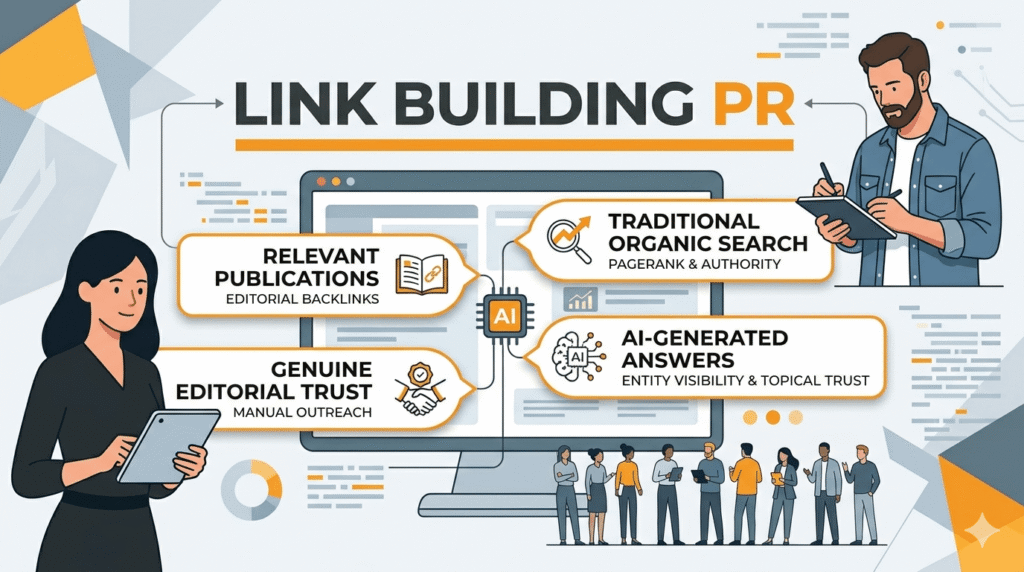
The case for digital PR links has two dimensions. The first is traditional organic search. The second is the rapidly evolving landscape of AI-generated answers.
Authority, Relevance, and Citations
Links from high-authority editorial sources pass more PageRank than the average backlink.
But beyond raw authority, they carry topical trust. That’s a signal that credible sources in your industry have independently validated your content as worth citing.
That distinction matters enormously right now. As Google continues to prioritize helpful, experience-backed content, the source quality of your backlink profile functions as a proxy for your site’s overall credibility.
A cluster of editorial backlinks from relevant publications tells a different story than the same number of links spread across niche guest post blogs.
The Page One Power team, writing in Search Engine Land, makes the case clearly. The safest long-term link building approach is to earn relevant backlinks through outreach, original content, and relationship building rather than automation-heavy volume tactics.
Manual, relationship-driven link building is more important now than it’s ever been, precisely because the tactics it can’t replicate (genuine editorial trust) are the ones that actually move the needle.
Mentions, Links, and Entity Visibility
Here’s the piece most link builders miss. AI search engines don’t just parse links. They parse the entire web of mentions, citations, and entity associations to build a model of what a brand is authoritative about.
When your brand appears consistently in the same publications that rank for a topic, AI systems begin to associate your entity with that topic.
That association influences how your brand appears in AI overviews, Perplexity answers, and other AI-generated responses, independently of whether those mentions carry a followed link.
This means digital PR has a second channel of value. It reinforces your brand entity. A campaign that earns coverage in ten relevant publications builds topical authority even if half those links are nofollow. The compound effect is greater visibility in both traditional and AI search.
The PR Link Building Workflow
Digital PR campaigns don’t succeed by accident. The ones that consistently earn top-tier coverage follow a repeatable process.
Research the Audience and Publication Targets
Start with the publications, not the pitch. Identify the outlets where your target audience actually reads. Think industry trades, national business media, vertical publications, niche newsletters. Then map the journalists who cover your topic area.
For each target, study what kinds of stories they’ve published recently, what data they tend to cite, and what gaps exist in their coverage. A financial journalist who writes about SaaS growth metrics is a completely different pitch target than a tech blogger covering software launches.
This research shapes everything downstream. If you don’t know what your targets care about, you can’t build an asset they’d want to cite.
Build a Linkable Asset
The asset is the foundation. Without something genuinely worth linking to, the rest of the process is just noise.
The best linkable assets tend to fall into a few categories. Original research with a surprising finding. An interactive tool that solves a real problem. A visual that makes a complex topic immediately clear. A perspective piece that challenges a widely held assumption with real evidence.
The critical word is “original.” Aggregating existing statistics doesn’t earn links. Producing new data, new analysis, or new utility does.
Find the Right Story Angle
The same data can be pitched a dozen ways, and most of them won’t land. The angle is what makes a journalist stop scrolling through their inbox.
Good angles answer one question. Why does this matter to my readers, right now?
Timeliness helps.
Surprise helps more.
If your data produces a finding that contradicts conventional wisdom in your industry, you have an angle. If it confirms what everyone already believed, you’re going to need a better hook.
A useful exercise is to write the headline you’d want to see in the publication before you write the pitch. If that headline doesn’t feel like something an editor would actually run, the angle needs work.
Create Media Lists
A media list is more than a spreadsheet of email addresses. It’s a prioritized, segmented list of contacts organized by publication tier, topic relevance, and relationship status.
Tier 1 targets get personalized, research-intensive pitches. Tier 2 gets adapted versions. Tier 3 is where you test angles before refining them for top-tier outreach.
Building this list properly means going beyond automated tools and actually reading the coverage. Note which writers have cited original research before, which have linked to third-party sources, and which tend to reference brands in your category.
Pitch and Follow Up
The pitch should be short, specific, and journalist-first. State why this story is relevant to their audience, what the key finding is, and what you can offer (embargo access, exclusive data, expert quotes). Four paragraphs is usually too long.
One follow-up is appropriate. Two is the maximum. Anything beyond that damages the relationship and your sender reputation.
→ Want help building a digital PR campaign for your industry? [Book a strategy call.]
Track Coverage and Links
Set up Google Alerts and media monitoring tools to catch coverage as it lands. Not every journalist who covers your story will tag you or include a link. A polite outreach asking for attribution can often convert a mention into a backlink.
Log every placement. Publication, URL, domain authority, link status (followed/nofollow/mention), anchor text, and date. This data feeds your measurement framework later.
Campaign Types That Earn Links
Different assets earn links from different publication types. Matching campaign type to target publication is half the strategy.
Data Studies
Original research is the highest-performing link acquisition format in most B2B verticals. A well-designed study with a surprising finding can generate dozens of editorial citations across a single news cycle.
The mechanics are straightforward. Survey your audience or analyze a proprietary dataset, identify findings that challenge common assumptions, and package the results as a downloadable report or interactive page. The press release becomes the pitch vehicle. Publications cite the source.
The key variable is methodology transparency. Journalists are more likely to cite data when the methodology is clearly explained and the sample size is credible.
Expert Commentary and Reactive PR
Reactive PR (sometimes called newsjacking) means monitoring the news cycle in your industry and offering expert commentary on breaking stories, fast enough to be quoted while the story is still live.
Services like HARO (Help a Reporter Out), Qwoted, and Connectively facilitate this. A journalist needs a source. You provide a precise, quotable answer. They include your name and potentially a link.
The key is specificity.
“We believe this trend will continue” earns nothing. “Based on our analysis of 643,000 SaaS domains, companies that doubled their link acquisition pace in 2024 saw a 34% reduction in time-to-first-page-rank” gives a journalist something to actually publish.
Original Tools, Calculators, or Visual Assets
Interactive tools are sticky link magnets.
A well-built calculator, configurator, or interactive visualization solves a genuine problem for a reader, and publications link to tools because they add value to their own content.
Original infographics and data visualizations work similarly, especially when they make a complex dataset visually parseable. The production cost is higher, but the link longevity is much greater than a standard news hook.
Case Studies
Detailed, results-focused case studies work particularly well for industry trade publications, which are constantly looking for real-world examples to accompany their educational content.
The bar is higher than standard content. Editors want specific metrics and verifiable outcomes. But the link quality from vertical publications tends to be exceptional for SEO.
Examples by Industry
SaaS
The SaaS market is fiercely competitive for links. With over 30,800 SaaS companies worldwide and experts projecting that number to double, standing out in link acquisition requires more than volume.
The good news is that SaaS companies have access to rich product and customer data that’s inherently linkable.
According to a study analyzing 643,805 SaaS domains, 78% of SaaS companies engaged in link building have used shareable content as a tactic for acquiring backlinks.
The most effective execute this through original benchmark reports, product usage data studies, and transparent “state of the industry” research that industry media legitimately want to cite.
SaaS companies that treat digital PR as a core acquisition channel rather than a supplementary one consistently outpace competitors in topical authority and branded search volume.
Ecommerce
Ecommerce digital PR tends to work best through trend data and consumer research.
Analyzing purchase trends across your catalog, surveying your customer base on behavior shifts, or producing seasonal data reports all give retail and lifestyle journalists the fresh data points they need for trend stories.
Product collaborations with credible organizations, especially non-profits or research institutions, can also generate high-authority editorial links that would otherwise be unavailable.
Local Services
Local services can punch above their weight in digital PR by focusing on hyper-local data.
A roofing company that publishes an annual report on storm damage patterns in their metro area, or a law firm that tracks local court data and publishes accessible summaries, can earn consistent links from regional news outlets.
The publications are smaller, but the topical and geographic relevance is excellent for both traditional local SEO and for AI answers that weight local authority.
B2B
B2B digital PR tends to work through trade publications, industry associations, and business media. The assets that perform best are those that help decision-makers do their jobs.
Think benchmark reports, salary studies, operational efficiency research, and analysis of industry-specific trends.
The relationship-building component matters more in B2B than in other sectors. A pattern of valuable contributions to trade media editors tends to unlock consistent coverage opportunities that one-off pitches rarely access.
Metrics That Matter
This is where most digital PR programs go wrong, and it’s worth being direct about it.
Links, Mentions, and Authority
The baseline metrics are total earned backlinks, referring domain count, domain authority trajectory, and the ratio of followed to total links in your recent acquisitions. These tell you whether the program is producing quantity and quality.
More granularly, track the topical relevance of linking domains (are links coming from sites that cover your industry?), the authority distribution of new links (are you earning links across the authority spectrum, or clustered at the low end?), and link velocity over time.
Referral Traffic and Conversions
Referral traffic is a useful secondary signal, but here’s where I’d urge caution.
After auditing the link profiles of significant numbers of B2B SaaS companies, the single most dangerous number I see in strategy decks is the one that treats referral traffic analysis as the primary measure of link building success.
Optimizing for referral clicks while pipeline stalls is celebrating vanity sessions. Measure referral traffic, but don’t let it drive your link strategy.
Better signals for revenue-minded teams are assisted conversions (sessions where a linked page appeared somewhere in the conversion path), pipeline velocity change within 90 days of a campaign landing, and brand search lift from pages that earned new links.
Brand Lift and AI Visibility
Increasingly, the most durable output of a digital PR campaign is not the backlink itself. It’s the compound brand entity reinforcement that accumulates across placements.
Track branded search volume before and after major campaigns. Monitor how your brand and key topic associations appear in AI Overview responses and AI-powered search platforms.
These signals are harder to attribute precisely, but they represent the long-term competitive moat that PR-driven link building builds uniquely well.
Common Mistakes
Over-Reliance on Press Releases
Press releases are useful for announcing newsworthy events to journalists who are already tracking you. They are not an effective standalone link building tactic.
Distributing boilerplate press releases through wire services generates noise, not editorial coverage. The links that appear on press release distribution platforms are typically low-authority and often nofollow. The journalists you actually want to reach don’t read them.
Use press releases as a supplement to direct journalist outreach, not as a substitute for it.
Weak Story Angles
The most common reason digital PR campaigns fail is an angle problem. The story simply isn’t interesting enough for a journalist to cover.
“Our company launched a new feature” is not an angle. “Our analysis of 50,000 sales calls found that deals involving this one discovery question close 23% faster” is an angle.
The difference is specificity, surprise, and genuine usefulness to a reporter’s readers.
Before any campaign goes out, pressure-test the angle with one question. “Would I read this headline if it appeared in my RSS feed today?” If the honest answer is no, revise the angle, not the pitch copy.
Poor Prospect Fit
Sending a B2B SaaS research study to lifestyle bloggers, or pitching a consumer trend report to an enterprise technology editor, wastes everyone’s time and burns goodwill with contacts you might need later.
Prospect fit is non-negotiable. Irrelevant pitches don’t just fail. They actively damage your sender reputation and reduce the likelihood that the same journalist opens your next email.
Build media lists with the same care you’d apply to an ABM sales prospecting list.
Tools and Templates
Outreach Template
Subject: [Data finding] + [publication-specific angle]
Hi [First name],

[One sentence on why this is relevant to their specific beat.]

We just published [asset type] showing [key finding with specific number].
[One sentence on why this finding matters right now.]

Happy to share the full dataset or arrange a quick call if useful.

[Name]
[Title, Company]
[URL to asset]
The subject line does most of the work. Lead with the data. Keep the body under 150 words.
Campaign Brief Template
Campaign Name:
Target publications (Tier 1 / Tier 2 / Tier 3):
Asset type:
Core finding / headline:
Data source and methodology:
Campaign live date:
Embargo date (if applicable):
Point of contact for media inquiries:
KPIs: [Links earned / Domain authority targets / Brand mention targets]
Fill this out before asset creation begins. Every decision downstream, the angle, format, and distribution list, should trace back to this brief.
Measurement Template
Campaign name:
Launch date:

LINKS
- Total links earned:
- Followed links:
- Tier 1 placements:
- Average DA of linking domains:

MENTIONS
- Total brand mentions (linked + unlinked):
- AI search appearances (manual check):

TRAFFIC
- Referral sessions from campaign URLs:
- CTA engagement rate from referral sessions:

PIPELINE
- Assisted conversions (within 90 days):
- Pipeline influenced (within 90 days):

BRAND
- Branded search volume change (30-day / 90-day):
- New entity associations in AI search:
Replace “How many visits?” with “Which link tier generated a demo request within 60 days?” That question forces the entire measurement conversation in the right direction.
FAQ
Is digital PR the same as link building?
Digital PR is a method of link building, specifically the method that earns editorial backlinks through media coverage. Link building is the broader category. Digital PR is one of the most sustainable approaches within it.
How long does it take to see results?
Most campaigns generate the bulk of their coverage within two to four weeks of launch. The authority impact on rankings typically takes 60 to 120 days, depending on the strength of the linking domains and the current state of your backlink profile.
How is digital PR different from reactive PR / HARO?
Reactive PR responds to existing journalist requests. Digital PR proactively creates assets that generate requests. Both earn editorial links, but proactive digital PR gives you more control over the quality of the placement and the relevance of the topic.
Do nofollow links from digital PR have any value?
Yes, especially for brand entity reinforcement and AI search visibility. A consistent pattern of nofollow mentions in high-authority publications still builds topical association and branded search lift, even without passing direct PageRank.
What’s a realistic link target for a digital PR campaign?
Campaign performance varies significantly by asset quality, industry, and distribution. Well-executed data studies from established brands in B2B niches tend to earn between 15 and 80 unique linking domains per campaign. First-time campaigns typically perform at the lower end until the brand builds media relationships.
How do I know if a pitch is good enough to send?
If you can’t articulate the story in one sentence and that sentence isn’t interesting to you personally, the pitch isn’t ready. A useful test is to show the headline to someone who doesn’t know your industry and ask if they’d click on it.
Conclusion
Digital PR links are not the easiest links to earn. They require original research, genuine storytelling, and sustained journalist relationships. They can’t be automated, and they can’t be purchased.
That’s precisely what makes them worth investing in.
The brands that dominate authority in competitive industries have largely earned it through exactly this kind of link building. The kind that produces genuine brand recognition, topical trust, and the compound effect of consistent editorial coverage.
For 42% of SaaS companies actively pursuing link building, strengthening brand recognition is already cited as a top priority, and the ones executing digital PR well are the ones pulling away from the pack.
The workflow in this guide is repeatable. The templates are a starting point. The measurement framework cuts through the noise to what actually moves pipeline.
The next step is deciding which campaign type fits where you are right now and building the asset that earns the coverage worth having.